Benefits Law Update
Practical advice from Verrill attorneys

On Labor Day, September 2, 1974, Gerald Ford signed the Employee Retirement Income Security Act (“ERISA”) into law.
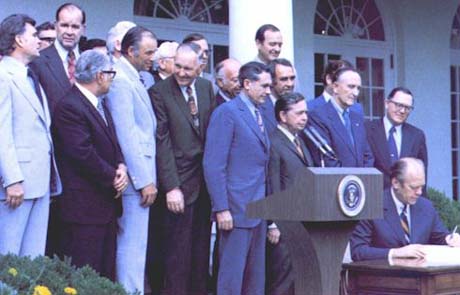
ERISA governs the employee benefit plans (i.e., retirement and welfare plans) of most private employers in the U.S., and it states, at length, why it was enacted. It declares that Congress recognized that the scope and number of benefit plans had grown substantially, “the well-being and security of millions of employees and their dependents are directly affected by these plans,” and “many employees with long years of employment” have been “deprived of anticipated benefits.”[1] As a result, Congress declared that the policy of the law includes protecting participants and beneficiaries by requiring disclosure and reporting of financial and other information (e.g., filing Forms 5500 and requiring the distribution of summary plan descriptions), by establishing standards of conduct and responsibility for plan fiduciaries (e.g., imposing fiduciary duties), by providing remedies for participants, and, with respect to pension plans, by imposing vesting, funding, and termination insurance requirements.[2]
In their textbook Pension and Employee Benefits Law (3rd ed., 2000), Professors John Langbein and Bruce Wolk outline the path culminating in ERISA’s enactment.[3] They use the 1963 “The Studebaker Incident” to illustrate the issues that spurred its passage. In that incident, the Studebaker Corporation announced the closing of a plant in South Bend, Indiana. The Studebaker pension plan was not fully funded, and, as a result, participants were divided into three groups:
One Studebaker participant who fell into the second group, Nolan Miller, testified before Congress. Mr. Miller, who was 59 years old, had worked at Studebaker for 38 years. He explained that it was “bitter news” when he learned that his pension was not secure. This type of story helped fuel the passage of ERISA.
However, not all plans are subject to ERISA. One type of plan not covered by ERISA is known as a “church plan.” Significantly, a church plan can be sponsored by a religiously affiliated organization such as a hospital.
This brings us to an article, Church Pensions Sidestep Oversight, published in the Wall Street Journal on February 26, 2025, 62 years after the Studebaker Incident and 51 years after ERISA was enacted. The article introduces the reader to Anne Hotaling, who joined St. Clare’s Hospital in Schenectady, New York, right out of nursing school in 1979, and indicated that one of the reasons she accepted a job at St. Clare’s was the promise of financial security provided by its pension plan. She earned a monthly pension from St. Clare’s of $1,449 for life. Unfortunately, St. Clare’s Hospital closed in 2008. However, it continued to inform her and others that their pensions were waiting and would be payable when they retired. When Ms. Hotaling retired, she received her first pension check. It was the last check she ever received from the pension plan. She was soon informed that the pension plan, which was a church plan, was nearly insolvent, and there were “not enough assets in the Plan to provide the benefits.” 1,100 participants in the St. Clare’s Hospital pension plan have lost all or part of their pension benefit.
The St. Clare’s Hospital incident provides a window into whether ERISA works. ERISA was designed, in part, to prevent future Studebaker-type incidents, and it has largely done so in the context of ERISA-covered plans. Although pension plan benefits can be reduced under ERISA’s insurance program, it is unlikely you will find an article about an ERISA-covered pension plan not providing any benefits because those plans are subject to the disclosure requirements, funding requirements, fiduciary obligations, and insurance obligations (through the Pension Benefit Guaranty Corporation (“PBGC”)) all referenced in Congress’s declaration of policy at Section 2 of ERISA. You will, however, see stories similar to the St. Clare’s Hospital incident concerning non-ERISA-covered plans. Even the Supreme Court acknowledged a “wave of litigation” about participants seeking redress from church plans in its 2017 decision, Advocate Health Care Network v. Stapleton.
Despite the intervening decades, the stories of Anne Hotaling and Nolan Miller are eerily similar. The primary common denominator is that they participated in pension plans that were not subject to ERISA. That does not prove that ERISA works, but if ERISA had applied, we know:
Congress’s declaration of policy clearly shows that it considered Studebaker-type incidents and the protection of plan participants and beneficiaries. It seems likely that if those ERISA policies had applied to the plans Ms. Hotaling and Mr. Miller participated in, they would not have lost all or most of their pension benefits just as they ended their working careers. In terms of protecting participants and avoiding Studebaker or St. Clare’s Hospital incidents, it appears that ERISA is working, at least for participants in plans that are subject to it.
Moving forward, important questions arise from these incidents, including whether ERISA should be expanded to cover more types of plans, whether the protections provided by ERISA are too costly, and what role state laws should or could play. It remains to be seen how these questions will be resolved.
[1] See ERISA Section 2(a).
[2] See ERISA Section 2(b) and (c).
[3] John H. Langbein and Bruce A. Wolk, Pension and Employee Benefits Law, 3rd ed. (St. Paul, MN: Foundation Press, 2000)

Verrill Attorney Annabel Rodriguez Named Top Women of Law by Massachusetts Lawyers Weekly
BOSTON, Massachusetts – Verrill attorney Annabel Rodriguez has been recognized as a Top Women of Law by Massachusetts Lawyers Weekly, and will be...What Employee Benefits Lawyers Do (and How to Make the Best Use of Us)
What do employee benefits lawyers do all day and how can clients make the best use of them? This post offers an overview of the kinds of things...Bloomberg Law Quotes Robert Keach on Expanded Access to Small Business Reorganization
Verrill attorney Bob Keach was recently featured in Bloomberg Law, discussing legislation that would raise debt limits for bankruptcy relief and...Phil Bartlett to Step Down as Chair of the Maine Public Utilities Commission
On September 15, 2026, Governor Janet Mills announced that Phil Bartlett will step down as Chair of the Maine Public Utilities Commission (PUC)...Jay McCormack and Michael Fee Co-Author AHLA Article on Skin Substitute Enforcement Trends
Verrill Partners Jay McCormack and Michael Fee co-authored an article for the American Health Law Association's Fraud and Abuse Practice Group...Verrill Welcomes Health Care & Life Sciences Attorney Elpida Velmahos
BOSTON, Massachusetts – Verrill is pleased to announce that Elpida Velmahos has joined the firm’s Health Care & Life Sciences Group as an...A New Protected Class in Maine: Holders of Final Protection Orders
In the lead-up to Domestic Violence Awareness Month in October, employers may be taking a closer look at how their policies and practices respond to...Verrill Secures SJC Victory for Boston Legacy FC in White Stadium Litigation
Verrill has secured a significant appellate victory for Boston Legacy FC in the litigation challenging the redevelopment of White Stadium in...