
Resources
Federal Trademark Registration – Part 2
Is your trademark registered? Should you register it? Why should you register it? What do you have to do? What does the process look like? Can you do it yourself or do you need to hire an attorney? These are just a few of the questions that business owners are faced with when considering whether and how to register their valuable trademarks. In this two-part overview of federal trademark registration, we answer these frequently asked questions. This part focuses on trademark prosecution. (Read part one: here).
Overview of Trademark Prosecution
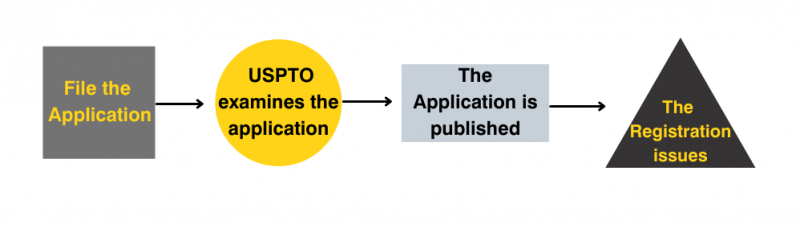
Trademark prosecution — the process of seeing an application through to registration — generally involves four or five milestones. These milestones depend on what kind of application you file.
In general, you need to be using the mark to secure a federal trademark registration. You do not, however, need to be using the mark to file an application. As such, there are two types of applications you can file with the USPTO: (1) a use-based application or (2) an intent-to-use (or “ITU”) application (There are other bases for applications, but these are outside of the scope of this article and generally will not apply to most U.S.-based businesses.). A use-based application is exactly what is sounds like — you are already using the mark in connection with the goods/services identified in the application. Conversely, an ITU application is based on your bona fide intent to use the mark in connection with the goods/services identified in the application — you have plans to use the mark in the relatively near future but want to get your application on file before doing so.
The prosecution of use-based and intent-to-use applications vary slightly, and we review these differences below.
With all of the above in mind, here are the general steps involved in prosecuting a U.S. trademark application.
- Clearance
While not required, it is highly recommended to clear a trademark to determine whether the mark is available for use and registration in the U.S. This involves conducting a search of the USPTO databases for potentially conflicting applications and registrations and of the internet to see if there are any conflicting common law uses. Once the mark clears, you can proceed to filing the application.
- Filing the Application
The next step is to file the application. The application lists (1) the trademark you wish to register; (2) the goods/services sold or to be sold under the trademark; and (3) the basis — use-based or intent-to-use — of the application. Once you have paid the required filing fees and the application is on file, it is assigned a filing date and a unique serial number.
- Examination
Several months after the application is filed, the USPTO will assign an examining attorney to review the application to determine if it is eligible for registration. Examination includes a search for conflicting marks; a review of the written application, the mark drawing, and any documentation filed in support of the application; and a determination of whether all fees have been paid. If the examining attorney finds no issues with the application, they will approve it for publication. This is extremely rare. In most cases (around 80–90% of cases), the examining attorney will refuse registration on one or several grounds in the form of an Office Action. Once you overcome all of the issues in the Office Action, the examining attorney will approve the application for publication.
- Publication
Next, marks are published for opposition. Publication entails a 30-day opposition period in which any third party can challenge the registration of a mark. If your application survives the publication period without incident or successfully overcomes or settles an opposition, your application will move to the next step.
- Notice of Allowance (ITU applications only)
If you filed an intent-to-use application, the USPTO will issue a “Notice of Allowance.” The Notice effectively states that your application is ready for registration once you submit acceptable evidence of use of the mark. You have three years to submit evidence of use of the mark once the Notice issues. You are allotted five six-month extensions in which to put the mark into use.
- Registration
Once your use-based application survives the opposition period or the evidence of use of your trademark is accepted after the Notice of Allowance issues, your mark will register. A registration certificate will issue assigning a registration date and a unique registration number.
- Maintenance
After the registration issues, you must make periodic maintenance filings proving to the USPTO that you are still using the mark (declarations of continuous use) and renewing the registration (renewal applications).
On paper, trademark prosecution is straight forward…
But this is rarely the case.
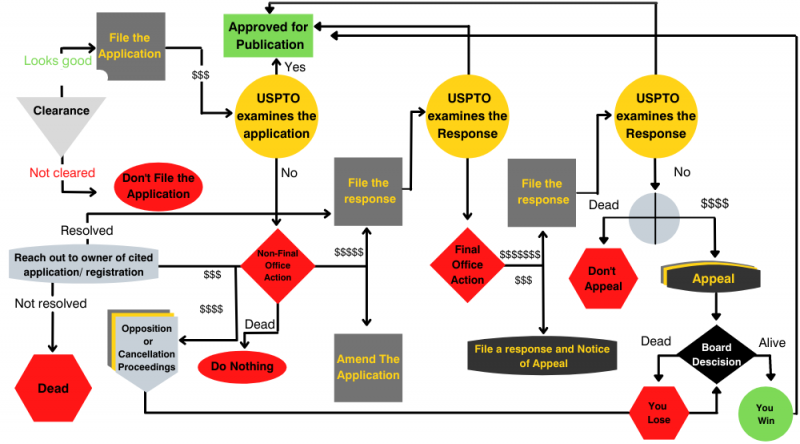
Seeing an application through to registration can be a complex, years-long endeavor. This is why trademark attorneys exist: to assist clients in navigating and understanding the complexities of trademark prosecution to make the appropriate strategic decisions for their businesses and trademark needs.
Can you (and should you) apply to register the mark on your own?
While you certainly can apply to register a trademark on your own, it is a potentially challenging prospect that may be best handled by an experienced attorney. The trademark attorneys at Verrill have years of experience advising clients on the availability of trademarks for use and registration and prosecuting applications before the USPTO. Contact us with any questions or to assist with your trademark matters.
Associated People

(207) 253 4424
Email