You Might Be a Winner
A blog from the attorneys of Verrill

Women in the kitchen and men in the wilderness. An ad concept as old as time. But has its time come? The U.S. has traditionally taken a hands-off approach to regulating “traditional” gender-stereotyping in ads. But this week, the U.K. has said enough is enough.
Apt for Father’s Day is the recent NY Times article entitled Gender Stereotypes Banned in British Advertising.
Thanks to our friends on the Internet, we can pull up loads of patently offensive gender-based stereotype advertising from the “good old days:

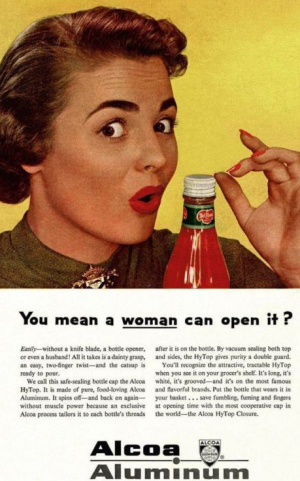
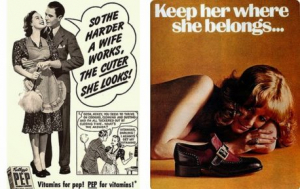
These good old days haven’t fully left us. As cited in the NY Times, the U.K.’s Advertising Standards Authority recently called out more recent troublesome ads, such as: (2016) Gucci using a a model who looked “unhealthily thin” in a campaign and (2019) a Porsche dealer ad showing a leather-clad woman up to her waist under a car with the tagline “attractive servicing.”
As a result, the U.K.’s Committee of Advertising Practice (CAP) recently provided Advertising Guidance in the UK for gender stereotyped ads.
The Advertising Guidance pointed to five specific gender-stereotypes in advertising that should be avoided:
On this side of the pond, we have no advertising guidelines for the depiction of gender stereotyping. The closest is in the Children’s Advertising Review Unit (CARU) self-regulatory rules for children’s advertising which states:
“Advertisers should avoid social stereotyping and appeals to prejudice, and are encouraged to incorporate minority and other groups in advertisements and to present positive role models whenever possible.”
While some advertisers may stick to the myth that gender stereotypes help sell products, the facts of the matter show that gender stereotypes are currently not based on facts.
Gender Stereotype Myths:
Why Does It Matter?
Don’t bite the hand that feeds you. On a practical level it matters because studies have shown that 85% of all consumer purchases are made by women and 75% of women are the primary shopper for the household.
Isn’t it our duty to make a better world for our kids? Ads depicting gender stereotypes don’t “mirror” these stereotypes but actually advance them. I cite two interesting television-related studies. In one, male interviewers watched sexist television commercials and then later judged female applicants as less competent and remembered more about their physical appearance than their biographical information. In another, children who were raised in households without televisions had less sex-typed perceptions. But when introduced to TV, these perceptions increased.
What Can We Do?
If you’re an advertiser, make sure your team is diverse – five 50-year old white men coming up with a Super Bowl commercial may not be the best game plan; and think long-term – consumers want to see commitment to change.
If you see offensive ads: Contact the brand or the FTC/FCC. Most importantly, talk to your kids about it. Like Whitney Houston, I believe the children are our future and maybe by the time they grow up, they won’t know about “dishpan hands” (1941) or “husband pleasing coffee” (1963) or that “cigarettes are like women – the best ones are thin and rich” (1967) or what’s meant by “it’s a wifesaver” (1973).
Of course there’s hope. After Ralph Kramden insisted that Alice could not go on the Raccoon Lodge’s annual fishing trip by uttering the above-titled phrase, later in this same episode, he relented and Alice and Trixie accompanied him and Ed – showing that both men and women can catch the fish. Final note: At the time of this Honeymooners episode, Ms. Joan Wulff was known as the best fly fisher in the world – and as one of our best-known female stereotypes, Baseball Annie says in Bull Durham, “You can look it up.”

Verrill Attorney Annabel Rodriguez Named Top Women of Law by Massachusetts Lawyers Weekly
BOSTON, Massachusetts – Verrill attorney Annabel Rodriguez has been recognized as a Top Women of Law by Massachusetts Lawyers Weekly, and will be...What Employee Benefits Lawyers Do (and How to Make the Best Use of Us)
What do employee benefits lawyers do all day and how can clients make the best use of them? This post offers an overview of the kinds of things...Bloomberg Law Quotes Robert Keach on Expanded Access to Small Business Reorganization
Verrill attorney Bob Keach was recently featured in Bloomberg Law, discussing legislation that would raise debt limits for bankruptcy relief and...Phil Bartlett to Step Down as Chair of the Maine Public Utilities Commission
On September 15, 2026, Governor Janet Mills announced that Phil Bartlett will step down as Chair of the Maine Public Utilities Commission (PUC)...Jay McCormack and Michael Fee Co-Author AHLA Article on Skin Substitute Enforcement Trends
Verrill Partners Jay McCormack and Michael Fee co-authored an article for the American Health Law Association's Fraud and Abuse Practice Group...Verrill Welcomes Health Care & Life Sciences Attorney Elpida Velmahos
BOSTON, Massachusetts – Verrill is pleased to announce that Elpida Velmahos has joined the firm’s Health Care & Life Sciences Group as an...A New Protected Class in Maine: Holders of Final Protection Orders
In the lead-up to Domestic Violence Awareness Month in October, employers may be taking a closer look at how their policies and practices respond to...Verrill Secures SJC Victory for Boston Legacy FC in White Stadium Litigation
Verrill has secured a significant appellate victory for Boston Legacy FC in the litigation challenging the redevelopment of White Stadium in...