Environmental and Energy Law Update
A blog from the attorneys of Verrill

If your facility handles hazardous chemicals, there is a good chance you are subject to one—or more—of the federal government’s chemical safety programs. But many facility owners, operators, Environmental, Health and Safety (EHS) managers, and environmental compliance officers remain unclear about what each program requires, where they overlap, and where they diverge.
The Verrill EHS team is excited to address these and other questions, in a forthcoming blog post series on chemical safety programs in the United States, focusing specifically on EPA’s Risk Management Program (RMP) and General Duty Clause (GDC), both under Section 112(r) of the Clean Air Act, and OSHA’s Process Safety Management (PSM) standard. These regulatory programs are complex and dynamic, and they carry some of the highest consequences in the world of environmental law. Noncompliance poses significant risk to businesses, employees, nearby communities, and the environment, and as a result, regulators enforce these programs with an intensity seldom seen elsewhere. Achieving compliance is a complex task, and many facilities (and even consultants) don’t know what they don’t know.
Verrill’s experience working directly with facilities and consultants to achieve compliance, often under the intense scrutiny of federal regulators and attorneys, gives our team a distinctive vantage point. We have defended facilities in high-stakes enforcement actions, supported technical audits, and analyzed some of the most complex RMP, PSM, and GDC issues for clients to inform business transactions and compliance strategies. This series will draw on that experience to discuss the applicability and requirements of each program, examine some of the thorniest regulatory concepts, such as RAGAGEP, the outer bounds of the GDC’s jurisdiction, and program exemptions like Meer and Retail Fuel, while also outlining practical steps facilities can take to achieve compliance. To set the foundation for the series, we start below with a practical overview of the three principal federal chemical safety programs: EPA’s RMP and GDC and OSHA’s PSM standard. We hope you enjoy reading these posts as much as we enjoy thinking and writing about them!
Chemical safety in the United States rests on three parallel federal programs administered by two different agencies. Although they share a common objective of preventing catastrophic chemical releases, they protect different groups:
OSHA created PSM in the early 1990s in response to several catastrophic chemical-release accidents. EPA later adopted much of its framework when building RMP, creating two parallel safety programs. While RMP and PSM are “sister” programs, they differ on definitions, chemical lists, exemptions, threshold quantities, and compliance obligations. Compliance with one does not mean compliance with the other. And unlike permit-based compliance, chemical safety programs are continuous and performance-based. They evolve with a facility’s operations, requiring iterative review to ensure ongoing compliance.
RMP applies to facilities that use a listed chemical in a “process” at or above a specified threshold quantity, for example, 10,000 pounds of anhydrous ammonia. PSM also applies to facilities with listed chemicals in a “process” at or above threshold quantities (although OSHA and EPA chemical lists, and the thresholds for the same chemical, may differ). Additionally, PSM covers processes that involve a Category 1 flammable gas, or a flammable liquid with a flashpoint below 100°F, on site in one location in quantities of 10,000 pounds or more, subject to limited exceptions for certain fuels and atmospheric storage. In determining RMP and PSM applicability, facilities should:
Separate applicability assessments should be performed under both RMP and PSM. The chemical lists, thresholds, and exemptions differ, so a facility covered by one program may not be covered by the other, or may have significant obligations under both.
The GDC is just one sentence in the Clean Air Act, but its reach is enormous. It applies to all “owners and operators of stationary sources producing, processing, handling or storing any extremely hazardous substance.” Unlike RMP and PSM, there are no listed chemicals and no threshold quantities under the GDC. If your facility handles an “extremely hazardous substance,” the GDC may apply regardless of the amount on site. However, what qualifies as an “extremely hazardous substance” for GDC purposes is ambiguous, as neither the Clean Air Act nor its implementing regulations define the term. EPA guidance, drawing on the Senate Report accompanying the 1990 Clean Air Act Amendments, points to a substance’s toxicity, reactivity, flammability, volatility, or corrosivity and its potential to cause death, injury, or property damage from short-term exposure. A chemical listed under RMP or EPCRA may qualify, but a chemical does not need to be on any list to fall within the GDC’s scope.
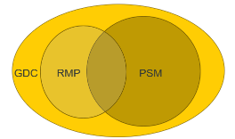
The GDC does not include threshold quantities, so keep in mind that a facility can be RMP/PSM-covered for one process but only GDC-covered for another. Alternatively, facilities that fall entirely outside the scope of RMP or PSM may still be subject to GDC obligations. Facilities in this final category often present the greatest risk because they inadvertently associate the absence of RMP and PSM obligations with the absence of any chemical safety obligations, when in fact, they may have significant obligations under the GDC. To make these overlapping layers of coverage easier to visualize, we developed the diagram below, a tool we use to represent where RMP, PSM, and the GDC each apply, where they intersect, and where a facility may have compliance obligations without realizing it.
Whether subject to RMP/PSM or not, facilities with GDC obligations must:
Facilities can meet these obligations by following relevant industry codes, recognized consensus standards, and practices tailored to their specific operations.
Whether subject to RMP, PSM, or the GDC, facilities should be aware of intensifying enforcement of chemical safety programs—especially by the EPA. Each year, many of EPA’s largest monetary penalties, across all regions, are issued within the RMP program. In 2023, EPA announced its National Enforcement and Compliance Initiatives (NECIs) for 2024–2027, renewing RMP/GDC enforcement as a priority. Anhydrous ammonia and hydrogen fluoride are singled out for inspection and enforcement. Beyond these listed chemicals, EPA has shown an increasing willingness to bring enforcement actions based solely on the GDC, even where a facility is not covered by RMP, resulting in significant penalties.
Facilities handling hazardous chemicals should not assume that meeting one program’s requirements satisfies the others. RMP and PSM are closely related but legally distinct, and the GDC casts a wider net than either. The RMP rule itself is also in flux: EPA proposed significant revisions to the 2024 RMP amendments in February 2026, although the existing compliance deadlines remain in effect unless and until a final rule changes them. With EPA actively enforcing these programs, including standalone GDC actions, now is a good time to review your facility’s compliance posture across all three.
For more information about the concepts discussed in Part 1 of this series, please contact Mat Todaro or Maye Emlein. And stay tuned for Part 2 which will be posted soon!
42 Verrill Attorneys Named 2026 Super Lawyers and Rising Stars
BOSTON, Mass.; BANGOR, Maine; PORTLAND, Maine; and WESTPORT, Conn. – Verrill is proud to announce that 42 attorneys have been recognized in the...Verrill Attorney Annabel Rodriguez Named Top Women of Law by Massachusetts Lawyers Weekly
BOSTON, Massachusetts – Verrill attorney Annabel Rodriguez has been recognized as a Top Women of Law by Massachusetts Lawyers Weekly, and will be...What Employee Benefits Lawyers Do (and How to Make the Best Use of Us)
What do employee benefits lawyers do all day and how can clients make the best use of them? This post offers an overview of the kinds of things...Bloomberg Law Quotes Robert Keach on Expanded Access to Small Business Reorganization
Verrill attorney Bob Keach was recently featured in Bloomberg Law, discussing legislation that would raise debt limits for bankruptcy relief and...Phil Bartlett to Step Down as Chair of the Maine Public Utilities Commission
On September 15, 2026, Governor Janet Mills announced that Phil Bartlett will step down as Chair of the Maine Public Utilities Commission (PUC)...Jay McCormack and Michael Fee Co-Author AHLA Article on Skin Substitute Enforcement Trends
Verrill Partners Jay McCormack and Michael Fee co-authored an article for the American Health Law Association's Fraud and Abuse Practice Group...Verrill Welcomes Health Care & Life Sciences Attorney Elpida Velmahos
BOSTON, Massachusetts – Verrill is pleased to announce that Elpida Velmahos has joined the firm’s Health Care & Life Sciences Group as an...